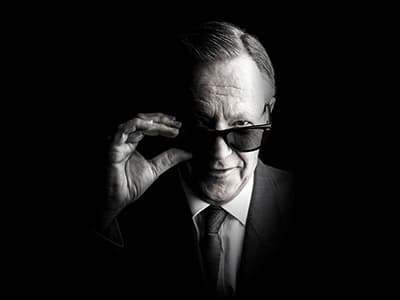
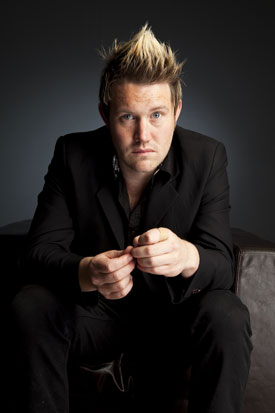
 Left – Eddie Perfect. Photo – James Penlidis
Sometimes there is a night in the theatre that you will never, ever forget. Watching Nigel Westlake conduct the NSW premier of his impressive new work, Missa Solis – Requiem for Eli for the Sydney Symphony with the Cantillation chorus was one of them.
Eli was Westlake’s 22 year old son who was tragically and deliberately run down by a drug addled, drunken driver three years ago. This requiem is Westlake’s way of laying his son’s spirit to rest.
Westlake’s requiem featured in a triple bill for the latest Meet the Music concert, part of the Sydney Symphony Education program, designed to present a diverse repertoire that ties in with the school syllabus. These concerts are by no means just for schools however. The audience comprised partly (very well behaved) school students and partly normal concert-goers who have cottoned on to the calibre of the concerts. The headline work is Beethoven’s Egmont, which is narrated by Eddie Perfect, who has a strong following among high school students and is an accomplished theatre performer.
The intention is to present a diverse program which includes a contemporary Australian work. Sydney Symphony has evidently put a lot of thought into creating this concert series as a strong audience development tool. Like its main subscription series, it begins with a 30 minute talk in the Northern Foyer of the Sydney Opera House to discuss the history, composer, context and major concerns in the works. For those who can’t make it before the performance, Andrew Ford introduces each work on the stage before the musicians begin. The talks help to make classical music more accessible, but to their credit, Sydney Symphony is not afraid of some more challenging programming and by no means sticks to exclusively accessible works.
The first work, Unanswered Question, a six minute piece by Charles Ives, was written one hundred years ago and yet is by far the most avant-garde piece on the bill. Ives asks the question of the meaning of life by having duelling sets of instruments arguing against each other – quiet strings symbolising our everyday existence, trumpets sounding the question ‘should there be more to this’ and 'fighting flutes' mocking the question in reply.
Preparing the audience for a difficult work (albeit only six minutes long) allows them to have a far better appreciation of it and be less likely perhaps to reject it as musically foreign.
Why can’t all performing arts performances provide this enrichment to their productions? Indeed, why can’t theatre companies do it? Sessions to explain productions already exist at the Sydney Theatre Company, but few audience members can make it to those. Perhaps a more effective alternative is to do what Andrew Ford does for music here. In two minutes Ford brings the composer and the narrative of the score alive for the audience.
A two minute briefing before the show covering history, concerns and elements of style could help theatre audiences with difficult plays. I have heard a lot of grumblings from audiences about the latest Joe Orton play at the STC. Perhaps a few primers about the theatrical conventions Orton employs, and the why he uses rapid fire, heightened language for his working class characters might help the audience better appreciate what he was trying to do and allow them to get much more out of the production. I do not suggest so much information as to expose theatre’s magic, but just enough to shed a little light. Just two minutes. It would be much less tiresome than panel discussions and Q&As following the show.
While Beethoven’s Egmont, narrated by Eddie Perfect, had the star billing, the new Westlake piece outshone it. It is a rare thing and a privilege to experience a work of art that is so intensely personal. In the pre-show talk, Genevieve Lang had to suppress tears as she confided that it had been an emotionally trying week not only for Westlake, but for the entire orchestra. The emotion in the orchestra as they played was palpable. Watching Westlake conduct this intensely moving elegy to his son was deeply poignant for the audience and it justly received a very long standing ovation.
The work, which is in eight movements, is a homage to the power of the sun and explores our relationship with it across different periods and cultures, from viewing it as a life force, to a god, to central to our scientific and philosophical understanding. Drawing from an eclectic range of inspiration allowed the work to shift in tone and style through the movements.
Missa Solis opens and concludes in the tradition of a requiem, using the lyrics of an Italian Renaissance madrigal, written by Giovan Leonardo Primavera, Nasce la gioia mia:
My joy is born
Every time I gaze at my beautiful sun
But my life dies
When I cannot look at it,
For the very sight is bliss to me.
These movements use a wide, modern, instrumental and choral vocabulary, at times wildly percussive, at others sounding very much like a film score (for which this music was originally written) and at others atonal. The middle movements, in turn, celebrate science with choral incantations about Tibetan Buddhism, the Northern Lights, the Egyptian sun god (a section featuring two boy sopranos, Liam Crisanti and Neil Baker), and Aten and Galileo’s reading of the stars which turned science, religion and philosophy on its head.
It is tempting to compare the work with Holst’s The Planets. Nigel Westlake originally wrote this score, now significantly reworked, for the Imax film Solarmax. Similarly, Beethoven’s Egmont is the incidental music written for Goethe’s heroic play, designed to support and enhance the drama.
In the Beethoven work, Eddie Perfect provides a brief narration of the story of Count Egmont, who fights the tyranny of a Spanish invading force and is ultimately put to death. His lover, Clara, kills herself after failing to rescue him. The dramatic score, written at a time when the Napoleonic forces were invading Vienna, is an expression of Beethoven’s great love of liberty and the values of democracy. However, Egmont is mostly known for its well known, sorrowful overture.
Masterfully conducted by Richard Gill, Egmont is most famous for its notable, contemplative overture and the mix of heroic and sorrowful tone that colours the rest of the work. Having been emotionally primed by the Westlake, the orchestra performed with both the brio and discipline the work deserved. Soprano, Kiandra Howarth, delivers Clara’s two solos with clarity and pathos. The first, Die Trommel geruhet!, is a call to arms; the second, a lament, Freudvoll und leidvoll.
Sydney Symphony presents
BEETHOVEN’S EGMONT: THE PERFECT HERO
IVES The Unanswered Question
WESTLAKE Missa Solis – Requiem for Eli* (SYDNEY PREMIERE)
BEETHOVEN Egmont
Conductor Richard Gill
Conductor* Nigel Westlake
Venue: Sydney Opera House Concert Hall
Dates/Times: Wed 19 – Thu 20 October 6.30pm; Friday 21 October 11am (Ives and Beethoven only)
Tickets: from $35 (booking fee may apply)
Bookings: 8215 4600 | www.sydneysymphony.com